
Puppy or Kangaroo? Puppy Jumping Tips
- BAXTER & Bella

- Dec 10, 2025
- 6 min read
by Bailey Coldwell
There is nothing quite like the love of a dog. However, this unconditional love can often be displayed in less than ideal ways, including jumping for attention. Puppies jump because they want to be closer to us. When they jump, they get closer to our hands and faces. What might seem cute as an 8-week-old fluffy, tiny puppy quickly becomes an annoyance. Let’s chat about trying to prevent the habit from starting and how to break the habit if it has already begun.
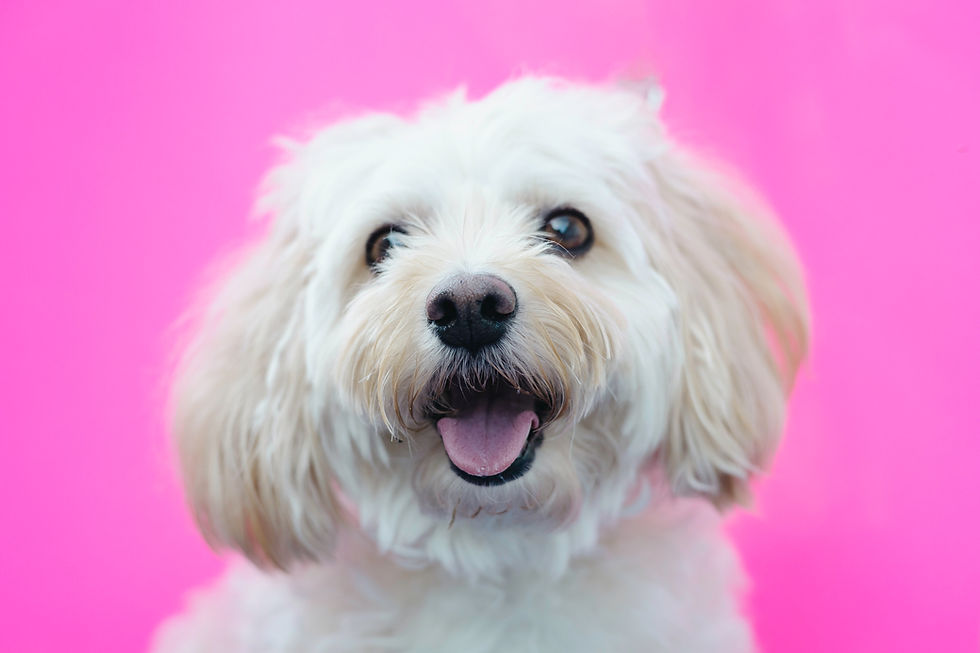
Why is breaking the habit of jumping so difficult? Because the actual act of making contact is rewarding. The goal of jumping on people is to get some form of attention. Once their paws are on us, it can be self-rewarding for dogs; therefore, they keep doing it. This is why dogs continue to do the jumping even after we turn our backs or try to ignore it. We can attempt to turn our back on our puppy, or we can try to redirect them 1-2 times or for a few seconds, but if the contact continues, we need to take it a step further. We need to actually stop or, ideally, prevent the contact.
Thinking about the ABCs of dog training, let’s look at the A (antecedent) of jumping. The antecedent is everything leading up to the B (behavior, in this case, the jumping). Try to predict when the puppy jumps. Is it when someone wakes up and comes downstairs in the morning? When someone comes home from work? When a guest comes over? Now, what are some ways that you can prevent that initial charging towards the person? Usually, this involves management of the environment. Use a leash, a crate, a pen, a baby gate, or other barrier to prevent the dog from immediately being able to charge and jump. This isn’t forever. This is to prevent the accidental reward of being able to make contact. Communicate with the people who are going to be attempting contact with your puppy. For household members, come up with a game plan. For example, the puppy should not be able to charge the door when someone comes home. Put a gate up in the entry way, have the puppy in a different area of the home, or in a crate if no one is home. This way, contact can not be made as soon as they enter the space. When someone is going to be entering the space, and there is someone else already with the puppy, communicate with them. This way, the person with the puppy can have the puppy on a leash or otherwise contained for when that person appears. Have treats ready to reward good behaviors or following the cues.
When guests come into the home, text or call them ahead of time to give gentle guidelines. An example:
“The puppy has been jumping, so she will be in another area of the home. Once she is calm, I will bring her out on a leash, or you can approach her behind the pen. If she starts to act up, I’d love to create space between you two.”
When in public, give the person a quick and simple statement. Two examples:
“We can try to say hi, but if he starts to jump, I am going to guide him away”.
And
“Oh, I am sorry, he is just too excited to say hi today. Thank you, though!”
It can be awkward and challenging to set these expectations, but if the puppy is sometimes able to get continued attention and contact for jumping, they will keep attempting it.
Let’s now dive into the C of the ABCs- the consequence. Is what I am doing after the behavior occurs, increasing or decreasing the likelihood of the jumping happening again? We aren’t perfect. Sometimes, the dog is still going to jump. How we respond is important. If the jumping happens, try to redirect 1-2 times, or for 5-10 seconds. Redirection can be asking for a cue, such as “sit” or “go to bed.” It can be just casually moving away or tossing a toy in the other direction. But if the contact keeps happening, we want to stop it. If you have a jumpy puppy, have “escape routes” nearby. These are areas you can guide your dog to or move yourself to in a timely manner to stop the contact. Removing the contact if the puppy is not easily redirected is important for the puppy to learn that the jumping doesn’t work. We can then try again once the energy level is calmer. Speaking of energy, don’t forget that puppies mirror our energy. Even though it is tempting to get upset at the puppy when they are jumping, try not to act upset. Be nonchalant and have a way to stop the contact if it does happen.
When a dog is in the habit of jumping, we want to teach an alternate behavior. Recreate the scenes that the puppy tends to jump in, during times when you can prevent the contact and reward the good behavior. Here are some alternative behaviors/cues to jumping that you can teach:
Sit to say please
Go to bed/Place
Crate
Down
Wait
Watch me
Heel
Say hi
Out
Here
Jump on
When teaching an alternative behavior, know that if the puppy is already overstimulated (zone 4), they are likely not going to respond well. You need to teach the puppy what these cues mean before trying to apply them in a real-time situation. If the puppy’s initial reaction to someone is to jump, bark, or lunge, first, we need to find a way to socialize and teach correct behavior from a distance or in less stimulating ways. Once your puppy can see a person and still be able to check in with you, we can advance to applying alternate cues. If you try to utilize a cue and they are not responding or do not perform the cue well (such as getting off the place or spot that you put them on), we want to guide them away from the person.
Be careful of getting into a cycle of constant redirection. If your puppy redirects from the jumping, great! But then we need to do something to help prevent the dog from doing the behavior again. Taking us back to the A (antecedent). Example. If the puppy jumps, you say “off”, and then the dog gets off the person, this is okay. But then, you want to do something to prevent the jumping again. This can be rewarding more before the jumping happens, giving an alternate cue, or managing the environment by using a leash or a pen. We don’t want the puppy to learn that in order to get attention, they first need to do the unwanted behavior. If my dog redirects well after an unwanted behavior, I try not to immediately give a reward. Instead, I do a few training cues or wait a few seconds to see if my dog truly has redirected and if they are able to completely transition to continuing with the good behavior. Then, I reward.
Less interaction is better than bad interaction. If you are too busy to prevent the behavior and teach the dog what to do instead, or you just don’t feel like dog training right then, just put the puppy elsewhere until you can prevent the behavior and teach an alternative behavior. Even if this means that the puppy has to spend a bit more time in a crate, behind a pen, or in another room. Know that your puppy might bark when they are separated. Just ignore it. We can ignore attention barking because they aren’t getting rewarded. We can’t ignore jumping and biting, because the contact is rewarding.
If your puppy is jumping on counters, tables, or other pieces of furniture that you don’t want, check out this blog post: https://www.baxterandbella.com/post/counter-surfing
I hope that this article helps you and your kangaroo… I mean your bunny….I mean your pogo stick…. I mean your PUPPY with the habit of jumping. If your dog has been doing this for a while, there is hope! It might take longer to break the habit, but with time and consistency, it is possible.


Comments